
How Prop Tracker numbers are calculated
What pass rate, return per evaluation, value and cost per funded, and the By firm table really measure.
Updated 2 min read
Where: Accounts → Prop Tracker → Dashboard
Check a number in the app
- In Prop Tracker, stay on the Dashboard tab.
- Hover the ⓘ next to any title to read how it is calculated.
- Scroll down to By firm. Hover the ⓘ next to Likely range, Cost per funded or $ per $1k of DD.
The rules behind the numbers
- An evaluation is each account you start in phase 1 or after a reset, with the accounts that follow it.
- It is finished when it gets funded, breaks or is archived unfinished. It is passed when it gets funded.
- Pass rate = passed ÷ finished. The likely range is where your true rate probably sits (95% Wilson interval).
- Value per funded: average payouts after split per passed evaluation. One without payouts counts as 0.
- Cost per funded = fees spent ÷ passed.
- Return per evaluation = pass rate × value per funded − spent ÷ evaluations. «2.0× its price» compares what you expect to collect with what each evaluation costs.
- $ per $1k of DD = evaluation fee ÷ phase 1 max drawdown × 1,000.
- In From purchase to payout, each % is over the step before. Survive day 1 means not breached on its first trading day.
- Instant funded accounts skip the evaluation, so they stay out of these numbers.
What's on the screen
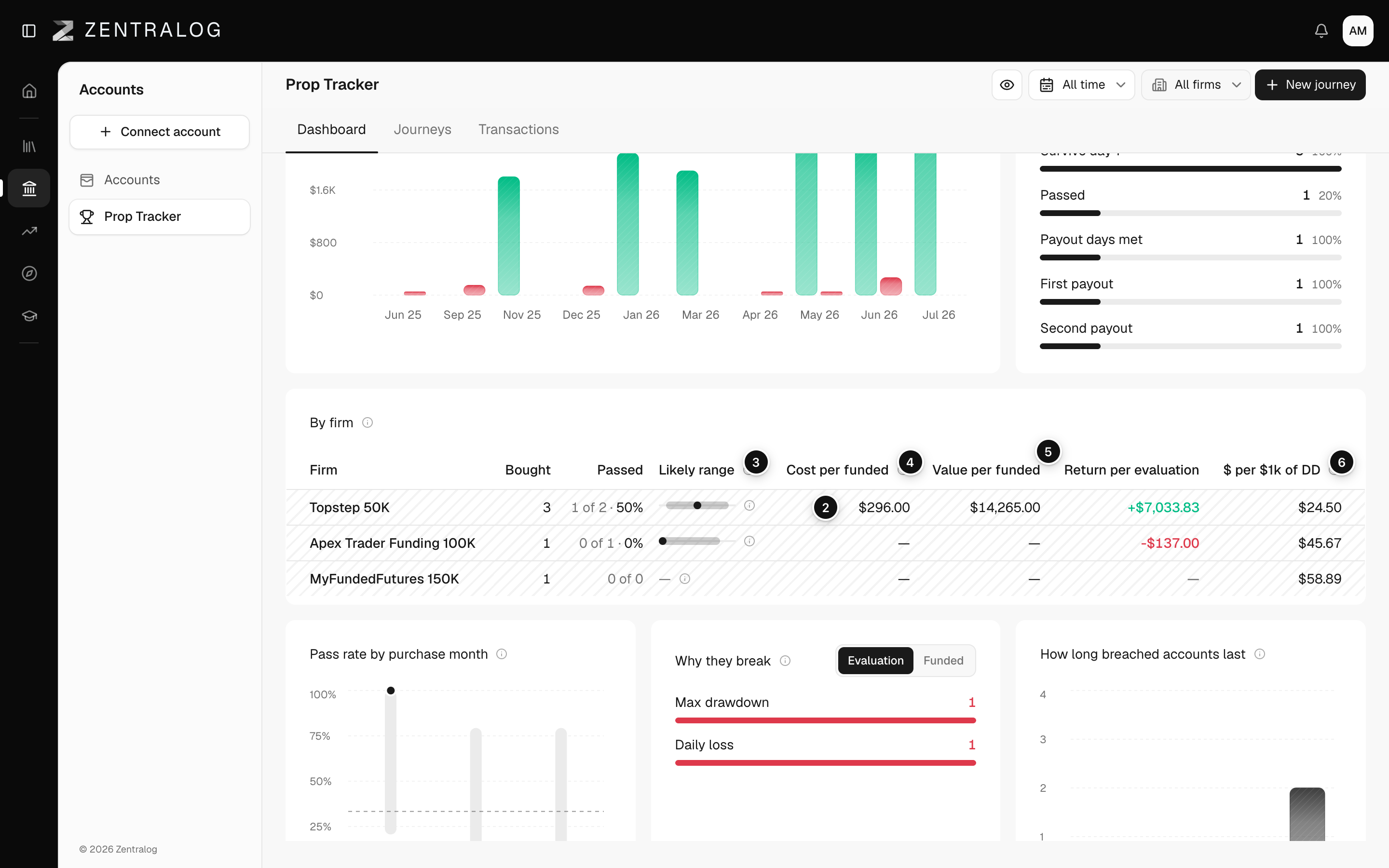
- Crown: the best return per evaluation among rows with 5 or more finished evaluations and a positive return.
- Striped row: fewer than 5 finished evaluations. The sample is small.
- Likely range: the 95% range of the pass rate for that row.
- Cost per funded: fees spent ÷ evaluations passed in that row.
- Return per evaluation: what each evaluation of that row leaves you on average.
- $ per $1k of DD: how much the evaluation costs per $1,000 of drawdown allowed.
With fewer than 5 finished evaluations the range is wide. Don't judge a firm by two tries.
FAQ
Why is Cost per funded different from a journey's Cost-to-fund?
Cost-to-fund, in a journey's Journey economy, counts only that journey's fees (cost-to-fund). Cost per funded spreads all your fees, failed evaluations included, over the ones you passed.
Why doesn't Passed in the funnel match the Pass rate?
The funnel counts funded accounts still trading. Pass rate only counts finished evaluations.
Related
Did this answer your question?